


Because of the french tendancy to not pronounce the last letter or two, I thought he was saying "chat" or cat. I could totally see how "Stop your cat!" could be used in that way, perhaps something about meowing on and on about the same thing, or the drama-queen dispositions of cats.
Alain and I were talking one evening, and there was some joke about cats. I was quite proud to use my new-found expression. I told him, in my best 'see how well I am learning French expressions' voice: "Arrete ton chat!" as a joke. He didn't quite understand, so I told him "You know, the expression 'arrete ton chat'?" (Geez, What kind of French is he if he doesn't know this expression?)
No, it's char! Char? what the heck is a char?
Apparently char is short for chariot. Also, it sounds like 'charrier' to exagerate.
"Nous avons là droit à un beau calembour, digne de l'Almanach Vermot et datant du milieu du XXe siècle. Cette expression est tout simplement un jeu de mot avec 'char', le véhicule, et 'charre', l'exagération, mot dérivé du verbe populaire 'charrier', exagérer. Elle assimile celui qu'on essaye d'arrêter de dire des bêtises au véhicule lancé à grande vitesse qu'il faut tenter de stopper.L'ajout du nom du conducteur est venu un peu après la naissance de l'expression, en 1959, à l'époque du succès du film Ben-Hur dont on sait qu'un des passages les plus spectaculaires est une course de chars dans la Rome antique."
"This is a pun dating back to the 20th century (wow! that long ago! ;)
This expression is simply a play on words of 'chariot', the vehicle, and 'charre', the exaggeration, the slang meaning of the popular verb 'charrier', to exaggerate (the verb can also mean to carry along or transport). It relates someone who tries to stop talking nonsense to the effort of stopping a large vehicle traveling at high speed.
The addition of the name of the driver ("Arrte ton char Ben-Hur") came shortly after the birth of the expression, in 1959, to the era of the success of the film Ben Hur, which includes as we well know the scenes of the chariot race in ancient Rome. "
Anyone want to share language gaffes that they have committed?
Speaking in French, I have a really hard time with the r sound. Like quatre (4) ca-tre and trois (3) t-wa. The worst is giving our phone number over the phone- it ends in 33- trente trois. Many times the person on the other side thinks I am saying 43- quarante trois. No! Twa Twa!
At least I don't say neuf (9) like noof anymore. It rhymes with snuff.
I can't really hear my accent when I am speaking of course, but hate hearing myself on recordings. Our answering machine is me speaking in English. Whenever I hear Americans or English people speaking French, I cringe in embarassment. I don't sound like THAT do I? Short answer- yeah, you do.
No surprise that people often ask me if I am English. I suppose all anglophones sound similar in French. At least English is considered one of the cute foreign accents, not trashy or low-class.

(Merde, for anyone who doesn't know, means s***)
You can "être dans la merde" to be in the s***
"merde alors!" Oh s***!
J'ai merdé à l'examen! I really screwed up the exam
merdeux/merdeuse: to feel s***ty
un petit merde: a little s*** (like the annoying kids next to me on the Metro the other day)
merdique: s***ty
emmerder: to get on someone's nerves
emmerdeur/emmerdeuse (make sure you get the right form for the right gender) someone who is a big pain
demerder: to get by, manage, get yourself out of s***
All of these definitions I took from the French-English dictionary. They take their s*** seriously.
I ended up reading the second one first, as I had bought it thinking that it was the first one. I finished it and went out and bought the first. So it is a bit disconcerting to read the first knowing what is going to happen (ie which girl he will end up with) but entertaining nevertheless. I am quite pleased to see some familiar themes explored- namely, frustrations with the Prefecture, french drivers, french food mishaps, strikes (namely transportation and garbage collectors), stepping in the merde, and trying to make oneself understood. Haven't read anything about La Poste yet, but perhaps the post offices are better in Paris. Also made me glad that I am not living in Paris. Marseille is big enough and culturally enough for me. It has enough museums, theaters, an opera, original version movie theaters, etc. to keep me happy. Furthermore, housing prices aren't sky-high (only skyscraper high) and it is close to other nice places to visit.
However, I do miss the American community.

It said the above (in French, Tout neveux debonnaire avoue et vote vanille). I knew what is saying, that is, each individual word. I just could not for the life of me get what it was trying to convey. Is it a joke? Is there some part of French culture that I JUST DO NOT GET?
When Alain and I took the Metro to go to a museum this weekend, I asked him about it. He looked at it for a moment and said
"Tous nos vouex de bonheur à vous et votre famille" (which is what it sounds like, phonetically).
This means "All our wishes of happiness to you and your family", which is a common New Year's greeting/wish.
Ah. I get it now.
A play on sounds.
Here are some French phrases that when spoken out loud (and quickly) sound like English phrases/questions. See if anyone can get them. (It helps if you know/speak French)
Ail ou radis? - Are you ready? (found by themikestand)
Qu'on gratte tous les jeunes! - Congratulations! (found by Starman)
Oui Arlette - We are late! (found by themikestand)
Ahmed a l'goût de tripes
Youssef vole ma femme au lit - You ---- my family (partially found by themikestand)
Sale teint de pépère - salt and pepper (found by themikestand)
Six tonnes de chair - Sit on the chair (found by themikestand)
Dix nourrices raidies - Dinner is ready! (found by themikestand)
Les slips tout gais serrent
Guy vomit sous mon nez - Give me some money! (found by themikestand)
Deux bouts de chair
Varices de grosseur - Where is the grocer? (found by themikestand)
C'est que ça pèle
Ma queue perd son alcool
I remember very early on, I stopped by a grocer's and was looking for strawberries. He asked if he could help and I said (in French) I am looking for strawberries. (fraises). He didn't understand. I repeated Fraise about ten different ways, varying the pronunciation each time, then started on the adjectives. Small, red, round, fruit, sweet? Nope. Still no clue. I left in despair.
Or when they hear the word and don't believe that they are hearing you right because you are a foreigner and it is an unusual request.
Such as when I went to the nearby bakery and wanted to know what the price would be for 100 small chocolate pastries for our wedding (sorry to everyone who came- no chocolate pastries).
Me: I would like to know the price of a hundred chocolate pastries there.
Baker: What?
Me: The price for a hundred.
Baker: How many?
Me: One Hundred.
Baker: A hundred?
Me: Yes, a hundred.
Baker: Really?
Me: Yes! One zero zero.
(he takes out a paper, writes 100 and shows it to me.)
Me: Yes, that is what I want to know.
Baker: Oh! A hundred. Well that will be....
(what is this? An Abbot and Costello routine? Just tell me the price please.)
Another thing I don't understand is why they have two words that sound alike and mean almost the same thing- dessus and dessous (above and below). Usually I can't manage to make the distinction in pronunciation so I pick one and say it, and then accompany it with the appropriate hand gesture (hand flat parallel to ground, waving near head level or down near waist). Quite useless of course when talking on the phone. I think it is dessus (deh-sue) and dessous (deh-soo) not to be confused with déçu (day-soo), which means disappointed. Sometimes these words that sound alike mean very different and embarrassing things.
lâcher- to let go
lécher- to lick.
ex/
Me: I want you to ______ me please.
Someone else: What? Really? Ok.
Me: Ahh!!!
Alain says he has trouble hearing the difference between Cheap, Sheep, and Ship. But at least they don't mean almost the same thing or something really embarrassing. If someone says, "That car is really sheep." You could probably figure out what they are trying to say. And it's not like we have above and apove (below).
One thing that I will say about French is that once you learn all the letter combinations and how to produce those sounds, it is usually the same pronunciation, versus English where you have to just about learn how to pronounce each word separately. Such as why are Sew (ohh) and Knew (ewww) different?
(Note to readers: tried to find a funny cartoon about French pronunciation, but Helas! could not)
Don't know how to say that in French? Me neither! Make it up!
As far as making stuff up, it is complicated but I will share some tidbits with you.
1) First of all, sound confident like you know that this is a real word. If you are lucky, they will think that they just don't know it. Say it quickly, don't stutter and stammer and pause to think.
2) As a starting point, take a noun, verb, adjective or adverb, and change it slightly to make another form. That way, people recognize the base at least.
3) Use it a lot. Try to get it to catch on.
First lesson: making a verb
For example:
To sneeze:
In English- short, sweet, to the point, sounds like the action.
In French- éternuer (verb)
J'éternue. What the heck? That doesn't sound like a sneeze at all. Plus, it makes me think of being naked. (être- to be, nu/nue- masculine and feminine forms of naked)
I much prefer "atchoum", the french version of Achoo.
Sidenote: do body noises sound different in different languages? Can a French dog communicate with an American dog?
To make a verb just add -er.
Atchoumer.
There. Perfect. Easy to conjugate and sounds like the action.
J'atchoume. Bless you. No no, I didn't sneeze, I was making a statement.
You can even make up past and future tenses.
While it is unlikely that you would ever need to say "At five tomorrow we will sneeze" it is there available for you, in case of an emergency.
"Demain, à 17h, nous atchoumerons."
Next example:
Socks and shoes
sock: chaussette
shoe: chaussure
French has a lot of pronominal verbs
brosser- to brush (say, the dog)
se brosser- to brush yourself (teeth, nosehair, earhair, etc.)
So why not make a pronominal verb out of putting something on your feet?
Take the root: chauss
add a SE before and an ER at the end and you get
se chausser- to put something on your feet, socks or shoes
Statement - What are you doing? Je me chausse.
Question- Tu te chausses?
Command- Chausses-toi!
Future- Il se chaussera.
Past- Nous nous sommes chaussés.
UPDATE: hold the phone! It actually IS a verb, though apparently not a pronominal one. Gosh, they really SHOULD pay me to make up words.
Next lesson: making an adjective
Alain and I were driving to Italy and drove past Nice, a very hilly area.
In English, this is of course very easy to say. It is very hilly here.
I tried to express this sentiment in French.
Colline- hill (coh- lean)
C'est très colliné ici. (pronounced coh-lee-nay)
Nope, there is no adjective for hilly. You have to say "There are a lot of hills here."
So my goal is to get five words (nouns, adjectives, or adverbs) integrated into the French language every year, or else one verb because they are more complicated.
French people reading this: you are now obligated to start using the word of the year, atchoumer. Learn it. Use it. Live it. Pass it on. Love it.
It would help if I was famous and on TV a lot. Alas and alack, my only recourse is to become President because then I could just make a law. For now, I will have to content myself with trying to slip one past Alain. As he knows me tendancy to make up words, it will be a challenge. I think I got this trait from my father, with his Kleene-X, Kleene-Y, and Kleene-Z, taking a showhim in the mornings instead of a showher, and his girelephants who eat banapples. Even my siblings for goodness sake argued about how to spell a made-up word- Stackle, for anyone wondering, is the cardboard tube in toilet paper and paper towels. We aren't all nuts. Mom is pretty normal.
But I think that if I can get a proven track record (and French nationality) in a few years I can present myself for election with the following slogan.
 French- no longer just for people who know how to speak it.
The first time I went, several weeks ago, I had a regular eye exam (quite an exercise in remembering the names of letters. F! No, E! I can see the letter, I just can't remember what it is called in French! Give me a minute!
He sent me home with a set of trial contacts, a bottle of solution, and some scary words sounding like Bifocals and muscular degeneration.
I came home, opened one of the contact lens packs, rinsed it off with the solution that he gave me (figuring it was a saline solution) and popped it into my eye.
And immediately screamed in pain. It was burning unbelievably. The eye's natural defense seems to be to close up as tight as possible and water like crazy so I had a heck of a time trying to get the Contact O' Fire out of my poor, red, squinty, watery eye. I finally managed to peel it out and rinsed out my eye with water and real saline solution as much as possible. I was supposed to go to class in half an hour but decided to skip it until my eye forgave me. I read the package of the solution- yep, just as I figured, for cleaning the lens, not rinsing. Ouch. Well, I learned my lesson about that one I guess- always double check medical stuff, especially in another language. Don't assume because it is in the same packaging and shape that it is the same stuff.
Yesterday I went back and had a follow up that was even more fun. It took about two and a half hours- they rechecked my prescription did some funny things with depth perception and stuff, though no bifocals thankfully, dilated my eyes (which I detest) and then the best part of all- he stuck a clear piece of plastic round and about two inches long directly onto my eyeball to see the insides or something.
I can just picture the scene now....
Doctor approaching patient's eyeball with a long sharp stick....
American Patient (in French): Ahh! What are you doing? Get that long pointy stick away from my eyeball!
Doctor (in French): Don't worry, it is part of the exam. I am going to take this long pointy stick and blah blah blah blah blah.
Patient (in French, panicking): What? I don't understand?!!!
Doctor (in French): There is nothing to be afraid of, it won't hurt a bit unless you blah blah blah blah blah. It is essential that you blah blah blah blah or else I will poke your eye out. Understand?
Patient (in French, hysterical by now): No! I don't understand! All I got was it is essential that I do something otherwise you will poke my eye out!
Doctor (in French, calmly, approaching closer): Yes, very good, now relax.
Patient (in French): Ahhh!! Nooo!!! Aaaaalllllaaaaiiiiinnnnnn!!!!!
(fade to black, curtain lowers)
Well, luckily I still have both eyes, and it was super fun stumbling home on a bright sunny day with my eyes dilated to let in as much light as possible and without my contacts. Miraculously managed to not step in any dog turds or get runover by a motorcycle. Thankfully, did not have to negociate the Metro. Apparently, I have to go back all of September, twice a week, to get my eyes Re-educated. I don't want my eyes to be re-educated. Granted, they didn't learn well the first time, but still. I don't look at myself every morning and think "Eyes, I have decided I am going to send you back for some higher education."
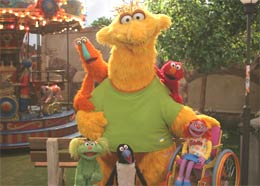
Today I discovered the wonders of Sesame Street in French. Apparently, it is fairly new here in France. Sadly, the only original American muppet making a guest appearance is the Cookie Monster.
Where is Big Bird? Who is this big yellow guy? What about Snuffelupagus? The Count? Oscar the Grouch?
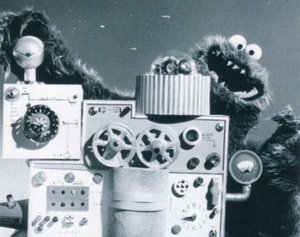 Picture on left- Cookie Monster eating an IBM Machine.
The letter of today was N, as Nid (nest) and Nez (nose). Olive introduced the letter, Cookie yelled Gateau! (cake!) and then proceeded to eat the big N. He is on a diet by the way, for everyone who didn't hear the tragic news last year. He can't go on a diet! Eating cookies and everything else, such as furniture, is what he does! The Origins of Cookie Monster and why is now on a diet- http://en.wikipedia.org/wiki/Cookie_Monster
The theme of the day was trash- big yellow guy Nac and his friend Yoyo were seen sweeping up trash on the street (yes children, learn this well!) and a pig sang a country song about trash accompanied by a trash can. I got excited at first, thinking it was Oscar in his trash can, but helas! no.
Gentle readers, you have not lived until you have seen a pig muppet accompanied by a trash can with two googly eyes singing a country song about trash in French.
Then we had educational bits about kite makers in Tibet, how to say "I made a mistake" in sign language, Nac singing about brushing your teeth, and how recycling works.
It was quite entertaining actually.
Here is a link to the French site.
http://www.france5.fr/zouzous/5-rue-sesame/personnages.htm
Notable characters include Georges a pinguin, and Baya a baker.
The other cartoon I really like is "Tibère et la maison bleue"
or "Bear and the Big Blue House" in English.
I urge you to go to this site, and click on one of the little videos. The three featured are about cleaning the house Le Ménage, the sun Le Soleil, and a toothbursh La Brosse à Dents. Apparently, the theme of brushing your teeth is big with kid's shows.
http://www.canalsatellite-reunion.com/espaceabonnes/tibere/chante_avec_moi.html
Even when I took one semester of French 101 in Virginia the teacher did this. Here in France, there is a TV show where a man comes on and reads a Dictée and the audience tries to write what he says, and the home audience can do the same. Oh Boy!
Here is an example of what you hear for a dictée.
"Leh bah-ca-laur-ay-at a faytay ses doo cent shans en doo meel un. Ceh dee-plome res poor ahn gran nohm-bre day joone jhan une ayta pahm-poor-tan dahn leur par-cour scolaire. Leh bah-ca-laur-ay-at day-mure un eggs-ahmen deefeecile ohs you day ghen-air-ah-tions deh joone lee-say-ens qui see pray-san shaq ahnay. Ce-day-pan-dan, dehpui lay loi deh ori-en-ta-tion deh mille noof sans cah-tre vahn noof, leh bah-ca-laur-ay-at ah chan-jay deh ohb-jec-tif. Il neh sah-jee plu deh leh con-fair-air ah oone aye-leete may deh loov-rir lar-jay-mahn ah twot lay coo-che deh la poh-puh-la-tion dahn sen sue-see dahc-say ah lah coul-ture poor toos. Il ee ah may-teh-nahn une grahnd dee-ver-see-tay deh bah-ca-laur-ay-at. Dahns quel-que shan-nays, la pluh-par days Fran-says sehron tee-too-layr deh ceh dee-plome qui ooh-vreh lay poort ah bow-coo dough-tre sehx-ah-men ooou cohn-coor."
So that is what you hear. I wonder if anyone who knows French can figure out my phonentic translation. Besides the words, the teachers says the ponctuation, such as comma, period, etc. I am getting better at guessing where the accents marks are supposed to go. It helps to have a reader who is good at reading dictees. It is EEM POHR TANT that they pronounce correctly, remember to say all of the punctuation marks, and don't get lost and skip words.
Anyway, here is what you are supposed to write.
"Le baccalauréat a fété ses deux cents ans en 2001. Ce diplôme reste pour un grand nombre de jeunes gens une étape important dans leur parcours scolaire. Le baccalauréat demeure un examen difficile aux yeux des générations de jeunes lycéens qui s'y présentent chaque année. Cependant, depuis les lois d'orientation de 1989, le baccalauréat a changé d'objectif. Il ne s'agit plus de le conférer à une élite mais de l'ouvrir largement à toutes les couches de la population dans un souci d'accès à la culture pour tous. Il y a maintenant une grande diversité de baccalauréats. Dans quelques années, la plupart des Français seront titulaires de ce diplôme qui ouvre les portes à beaucoup d'autres examens ou concours."
Eet ees vair-ry dee-fee-coolt.
Mademoiselle is technically for all unmarried women, whether they are 12 or 72. But I think most people would not call an older woman Mademoiselle, especially if they were unsure of her status.
Another blog discussion on this.
http://www.nakedtranslations.com/en/2006/05/000617.php
And further
http://www.msnbc.msn.com/id/11923774/
While I wouldn't launch a petition to remove the word entirely from the vocabulary, it does seem strange to be confronted with it on an hourly basis. In the US most people do not use Miss to address women, it is usually Ms or Mrs. On the other hand, non married women say that it makes them feel old to be called Madame sometimes.
1. I actually like French Rap.
2. You can understand the lyrics.
3. The lyrics are not all bleeped out.
(ex. US- (from pretty much any song) You BLEEP when you BLEEP with a BLEEP in the BLEEP and a BLEEP.
France- (from the song "La Belle et Le BadBoy" by MC Solaar) Ils s'etaient rencontres sur les bancs d'l'ecole[They met back in school]Entre une heure de colle de maths ou d'un cours d'espagnol[Between a math class and a spanish class]C'etait un fille fun fana de football[She was a soccer fan]Lui ne craignait pas les balles, c'etait le goal[But he didn't fear balls, it was the goal]C'qu'il lui promettait c'etait des ballades en Corvette[Only thing he promised was rides in a Corvette]Pour l'instant en survet, il volait des mobylettes[But for now, he was stealing scooters]) (note: not my translation)
4. The subjects seem, for the most part, to be socially conscious. Not only are they are complaining about something, they are trying to suggest solutions.
5. They sound melodious.
So once you get past the fact that, Dude, they are RAPPING in French (for which I am sure all the kings and leaders of the Revolution are rolling over in the graves ) it isn't so bad.
When people stop me in the streets to ask a question, "What time is it?" "Can you tell me where the nearest Metro station is?" etc. and I try to answer, or ask them to repeat the question, often I get "Oh. You are not French. Never mind." Like I couldn't possibly say "It is 4:30" in French or at least point and grunt.
I was in the mall a few months ago. A woman was standing outside a store, handing out things. She called me over, out of curiousity I went. She handed me a card for the store, a bookstore. She was asking me things like how many books I read per month, etc. Well, I obviously took too long to reflect on that question, so she said "Oh. you are not French are you?" and took the card back. Ok, that was nice. I explained this to Alain, thinking that perhaps for some reason only French nationals could get that discount. He said that he thought it was more that she figured I wouldn't read French books. Yes, because foreigners who are in France trying to learn French would never try to actually READ a French book!
Now granted if a opinion pollster stops me in the street and wants my feelings on the current state of French foreign affairs, I am probably going to say "I don't know" and runaway. But I do know basic numbers, directions, yes, no, etc.
Today I was walking back from taking out the trash, and a woman approached me. She wasn't really looking at me while posing her quesion. One of those "I am too busy and important to actually look at you, but I need you to help me" kind of people. She posed a question in a mumbling, distracted manner. I gathered that she was looking for a market or store. I said Pardon? She said "Oh you are not French." and wandered off without saying excuse me, or sorry for bothering you, or goodbye, or anything at all. Argh!
Though I admit that sometimes it is helpful at times, even when I know perfectly the question. "Hi! We would like to tell you about our new long-distance service! Do you have 30 minutes to listen to me blab on and on?"
- What? I am sorry. I don't understand. I am not French. Goodbye.
Basically, as an adult, when first meeting someone or with a stranger (say a shopkeeper or someone you ask directions from in the street), you use Vous. But, sometimes if a friend presents you to one of their friends, you can use Tu right away. If you start off with Vous, then eventually, the other person might say "Ok, you can use Tu with me now." It is an act of friendship and recognition. There are even verbs for it, tutoyer and vouvoyer. Or if someone is being too familiar with you, you can say, "Oh, I am not your friend. You can vouvoyer me."
A webarticle on it
http://www.thewritefrenchlife.com/TuorVous.html
With children, you usually address them as Tu. Then they can address you as vous or tu. Students and teachers, it depends. French children have trouble to use Tu with their professors.
On a forum the question was posed
"if you were to switch to vous with someone with whom you usually tutoyer, wouldthe general response seemed to be
it in a way be a ruder form, as if you are being cold and distant? For example, suppose that a friend of yours does something that really upsets you; could you
vouvoyer them to let them know that you are not happy with them?"
"in my experience once you start saying tu to someone you never revert to
saying vous. "and "Yes, it's quite a slap in the face actually and they'll wonder what they've done to you. Once you start 'tutoyer' someone there's no going back."
and oppositely
"I remember reading an interview of Brigitte Bardot (who comes from quite aSound confusing? Yes, it is. When in doubt, follow the french person's lead. Sometimes, I am not sure how the vous form is pronounced, because I usually learn the Je (I) form first, which usually sounds like the Tu form and the 3rd person singular (he, she) form. Thankfully, one can use the universal On- which can be you, me, a person in general, or us.
posh family) in which she told a story about her childhood: one day she and her
sister broke a precious vase and as a punishment her parents started to say
'vous' to both children on the spot. They never used 'tu' again. Little Brigitte
was absolutely distraught and never forgave them, even as an adult."
Somehow "assess information" became "information of donkeys". Gotta love the way that computers think. Another thing that needs to be done is to write out the cover letter by hand on unlined paper. I guess they like to see your handwriting for personality analysis purposes. This could be less than good.
Numbers 1-16 are pretty simple, except I can't tell the difference between 2 (deux) and 12 (doze).
17-19 are dix-sept (ten seven), dix-huit (ten eight), dix-neuf (ten nine)
I used to pronounce 9 like noove, which Alain thought was funny. Apparently, it rhymes with snuff.
20-69 are pretty normal, but after 69 it gets tricky.
70= soixante dix (sixty ten)
71= soixante et onze (sixty eleven)
72= soixante et doze (sixty twelve)
77= soixante dix sept (sixty ten seven)
etc til 80
80= quatre vingt (four twenties)
81=quatre vingt un (four twenties one)
etc
90=quatre vingt dix
etc
97=quatre vingt dix sept (four twenties ten seven)
til 100.
At least in English it is just Seventy Seven, Eighty Seven, etc. Not four twenties, a five, a two plus a seven, minus a four.
The alphabet is pretty regular, all the same letters. Except e is pronouned euh, i is eee, g is jay, and j is gee.
There are the accent marks too
é è ê ë à ç etc.
Example: Je mange la pomme. (I eat the apple.)
Je la mange. (I eat it)
In the passé composée form it gets interesting. Since apple is the direct object, the ending of the verb has to accord with it.
Je l'ai mangée.
But if there is no direct object, such as I ate yesterday, it is just
J'ai mangé hier.
It can be difficult to guess what gender the noun is, as there doesn't seem to be any logical assignment of the gender.
lipstick : le rouge à lèvres
tampon: le tampon
(side note: tampon can also be stamps, which leads for some interesting store signs. Kind of like the Supermaxi grocery store in Ecuador.)
The passé composée verbs can be conjugated with être (to be) or avoir (to have). When I took Intro to French back at UVA, I mistakenly thought that it was a direct translation of english, such as
Je suis entrée (I was entering)
But no, it is entered. Note the extra e at the end of entrée when a woman is speaking.
For a man: Je suis entrée.
For we: Nous sommes entrés (for a mixed gender group)
but for a group of women: Nous sommes entrées.
It can be very confusing sometimes. Especially as you cannot hear the difference in the pronounciation, only can guess by the context and who is talking. Same as with the 3rd person singular he/she il/elle, and the 3rd person plural they ils/elles, many times, but not always, the verb endings sound the same.

Going to the Post office is always an interesting study in communication.
Me: (pointing at box) "Boite"
Clerk: rapid stream of french.
Me: (to send) "Envoyer"
Clerk: (in french) To some foreign place?
(why do they always assume that? Do I seem foreign to them?!)
Heaven help me if I need to send something with insurance, to get a tracking number, or something out of the ordinary.
Tuesday I received a note saying I had a package, and to come pick it up. I went a little after they opened, got to the window and presented my slip. Oh no, we can't give that to you now, you have to come back after 10 am. Why, the packages are right in that room right there? Just because.
I return after ten and again present my slip. The clerk goes into the back, rummages around for awhile, and returns with a box, asking what my first name is. Megan.
The box was address to Dominque Schmidt, which even in French must be a long cry from Megan Smith. The address was completely different as well- street and number. I'm thinking there was no one by that name at that address, so they searched within a ten block radius to see who has a name even remotely similar. Sigh. And I was so excited about receiving a package too.
La Poste is where we have our bank account too. It is helpful in that it is right across the street and has an ATM. For any actual money transactions though (depositing checks, changing currency, etc) it might as well be non existent. Oh no, you can't change money here. You have to go to the larger post office. Sure, we can deposit that $50 American check for you. But it will cost $40 in fees. Getting my name added to the account was laughable as it took about 2 months to do it. We mistakenly made our first attempt in August, when all private companies are on vacation and the public services only pretend to work. They now have me listed on his account as M. Alain P____ and ith.
Favorite Posts
-
 I picked up my French passport this morning. It has been ready for awhile, I received the text message saying it was available for pick-up a...
 -
 My Husband: (photo courtesy of Yahoo!) I just couldn't resist. A frog on a bright green motorcycle. (and his name is Oui) The...
 -
 The above cartoon for kids to color, cut out, and fold into a cube shape. Then the cube is to be placed in the center of the table for remi...
 -
Got back from Strasbourg just fine. My wallet however, did not. After my long train trip back home, and being called "sale race" (...
-
The more I (sorta) learn another language, the more am I amazed at how many concepts, words, phrases, expressions etc. in one language don...
-
 Come to an end. My maternity leave is ending and I return to work on Monday. Alain will then take his two weeks of paternity leave, then we...
 -
Today I am going over to visit Alain's parents, Jacques and Josée for lunch. Alain is gone for a week for work. I proudly announced that...
-
 Here is the other cross-stitch I finished this year, this one is for Alain's Aunt, Lydia. I have now done at least one for every hous...
 -
Someone had other plans. Our daughter S. decided to make her appearance weeks ahead of schedule. (We have decided not to post her full name,...
-
One thing that you learn very quickly when starting to learn french is that absolutely everything has a gender. And you had better know it, ...
